
Touring 101: Why the Live Experience Matters More Than Ever
For decades, touring was one part of an artist’s career. Today, it carries significantly more weight.
Streaming has made listening easier, cheaper, and more convenient, while the cost and commitment required to attend a concert have moved in the opposite direction. A fan isn’t just buying a ticket. They may be paying for transportation, parking, food, drinks, merchandise, childcare, a hotel, or simply giving up an evening they could have spent somewhere else.
That changes the question behind every ticket purchase. It’s no longer simply, Do I like this artist? Increasingly, it’s: Is this night worth it?
The artists building strong live businesses understand that a show cannot simply be a physical version of the streaming experience. It has to offer something streaming cannot: a room, a memory, a world, and each other.
The live experience is no longer just what happens after an artist builds an audience. It can be one of the most important ways they deepen it.
Quick Answer: How Do Artists Build a Strong Live Experience?
A strong live experience turns passive listeners into active participants in an artist’s world. Music creates the initial demand, but sustainable touring requires artists and their teams to understand who will actually buy tickets, choose rooms that reflect that demand, and create an experience valuable enough to justify everything a fan invests in attending.
That relationship shouldn’t end when the lights come up. The strongest live strategies also consider what happens after the show: who attended, how the artist stays connected to them, and what gives those fans a reason to come back.
The goal isn’t simply to sell a ticket. It’s to create an experience people want to return to.
Explore The Live Experience Visual Report
Concert Tickets Are Getting More Expensive
The economics of going to a concert have changed dramatically. Average ticket prices cited in the original report increased from $26 in 1996 to $133 in 2025—a 412% increase—and the ticket itself is only one part of what a fan may spend.
Transportation, parking, food, drinks, merchandise, childcare, hotels for destination shows, and time away from other responsibilities can all become part of the cost of attending. As that investment grows, so does the standard fans use to decide whether a night out is worth it.
That puts more pressure on the live experience itself. Hearing songs performed in person may be the foundation of a concert, but increasingly, the value of the night has to extend beyond that.
Why Is Everybody on Tour?
For most artists, streaming alone does not sustain a career, which makes touring an important part of the modern artist business. But having streams does not automatically mean an artist has a live audience.
That is one of the biggest misconceptions in music. Millions of streams do not guarantee sold-out shows, just as one viral record does not create lasting ticket demand. A bigger room does not automatically signal greater success, and headlining is not always the smartest next step.
Sometimes a smaller sold-out room creates the stronger experience. Sometimes the right support slot puts an artist in front of thousands of potential new fans without forcing them to manufacture headline demand that doesn’t exist yet.
Tour strategy has to follow actual demand rather than perception.
The Tour Economy Has Multiple Levels
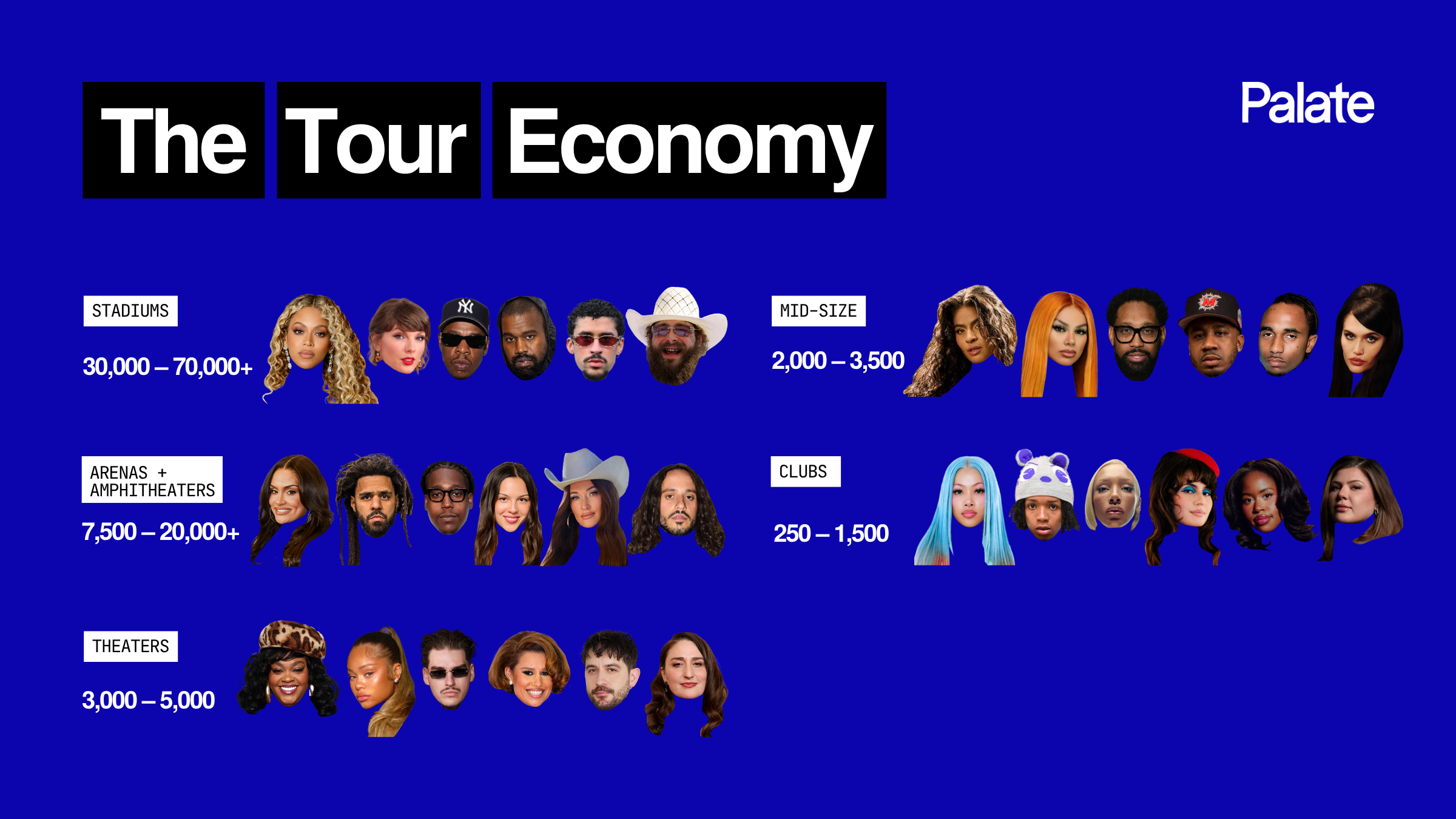
There is no single definition of a successful tour. The live economy extends from clubs and mid-size venues to theaters, amphitheaters, arenas, and stadiums, with each level representing a different stage of audience development.
An artist selling out a 500-capacity club can have a healthier live business than an artist struggling to fill a room three times the size. Venue size should reflect the audience that is actually willing to show up, not the size that makes the career appear most impressive from the outside.
Choosing the right room is therefore one of the most important decisions an artist and their team can make. Demand, not ego, should determine the room.
Streams Don’t Equal Tickets
Streaming measures listening. Ticket sales measure intention.
Those behaviors are related, but they are not interchangeable. Someone can discover a song through a playlist, hear it repeatedly, and never develop a meaningful relationship with the artist behind it. Buying a concert ticket requires something more: money, planning, travel, time, and a decision to dedicate part of the day to that artist.
That is a significantly higher level of commitment, which is why streaming numbers alone can be misleading when determining touring strategy. What matters is whether passive consumption has developed into enough attachment that someone wants to be physically present.
The Three Levels of Fan Demand
A useful way to think about live demand is as a progression:
THE SONG
“I like the record.”
THE ARTIST
“I really rock with them.”
THE EXPERIENCE
“I need to see this live.”
The goal is to move people from one level to the next. A successful song can create attention, but a strong artist identity gives that attention somewhere to attach. The live experience then gives the fan an opportunity to participate in the artist’s world rather than simply consume it.
The strongest touring careers eventually need all three. The song creates the entry point, the artist creates the relationship, and the experience creates a reason to show up.
Are You Actually Ready to Tour?
Tour readiness is bigger than monthly listeners. Before putting dates on sale, artists should look at the complete picture: music, catalog, social activity, radio, live show, pricing, packaging, fan community, timing, and existing market demand.
An artist may have a strong record but not enough catalog for a compelling headline show. Another may have an engaged social following that is concentrated in only a handful of markets. Another may have genuine demand but a ticket price or venue strategy that doesn’t match the audience.
Touring has a way of exposing weaknesses that streaming can hide. Digital numbers can tell a team that people are listening; ticket sales reveal whether enough of those people care enough to show up.
Ticket Pricing Is Part of the Experience
Fans want affordable shows. Artists also have to pay for them.
Consider a 300-capacity room with $25 tickets. A sellout generates $7,500 gross before accounting for venue costs, crew, travel, hotels, production, and marketing. The money can disappear quickly, which creates a real tension between accessibility for the audience and sustainability for the artist.
There is no universal ticket price that solves that tension. The larger lesson is that pricing cannot be separated from the experience or from the economics required to produce it. A ticket needs to make sense for the audience while still giving the artist a viable path to putting on the show.
There Is More Than One Way to Experience Live Music
Not every compelling live experience needs to follow the traditional concert model. Different artists can build live experiences around entirely different audience needs.
The Bundle combines music with another activity or attraction. The Intimate Room makes proximity, comfort, or access part of the premium. The Festival uses an existing audience as a platform for discovery and cultural relevance. The World creates an environment compelling enough that fans are willing to travel to enter it.
A fan might want spectacle one night and an intimate table with dinner and drinks another. The opportunity is to design the live experience around the artist and their audience rather than assuming every career should eventually lead to the same kind of show.
Festivals Are Discovery Platforms
Festivals occupy a unique place in the live ecosystem because artists are stepping into an audience that already exists. Some festivals are built around discovery, others around a specific genre or culture, while major festivals can offer artists exposure to an enormous mainstream audience.
But simply appearing on the lineup is not necessarily enough. The more useful question is: What will people remember?
Signature choreography, a surprising mashup, a distinctive visual, crowd interaction, or another recognizable performance moment can give an appearance a life beyond the festival itself. Those moments travel through social media, fan footage, press, and conversation long after the set ends.
The artist is temporarily borrowing the festival’s audience. The goal is to leave with some of them.
Build the World Before You Build the Stage
The strongest tours often begin before anyone walks into the venue. Album artwork, styling, merchandise, social content, stage design, and performance can all teach the audience the visual language of an era before the first show begins.
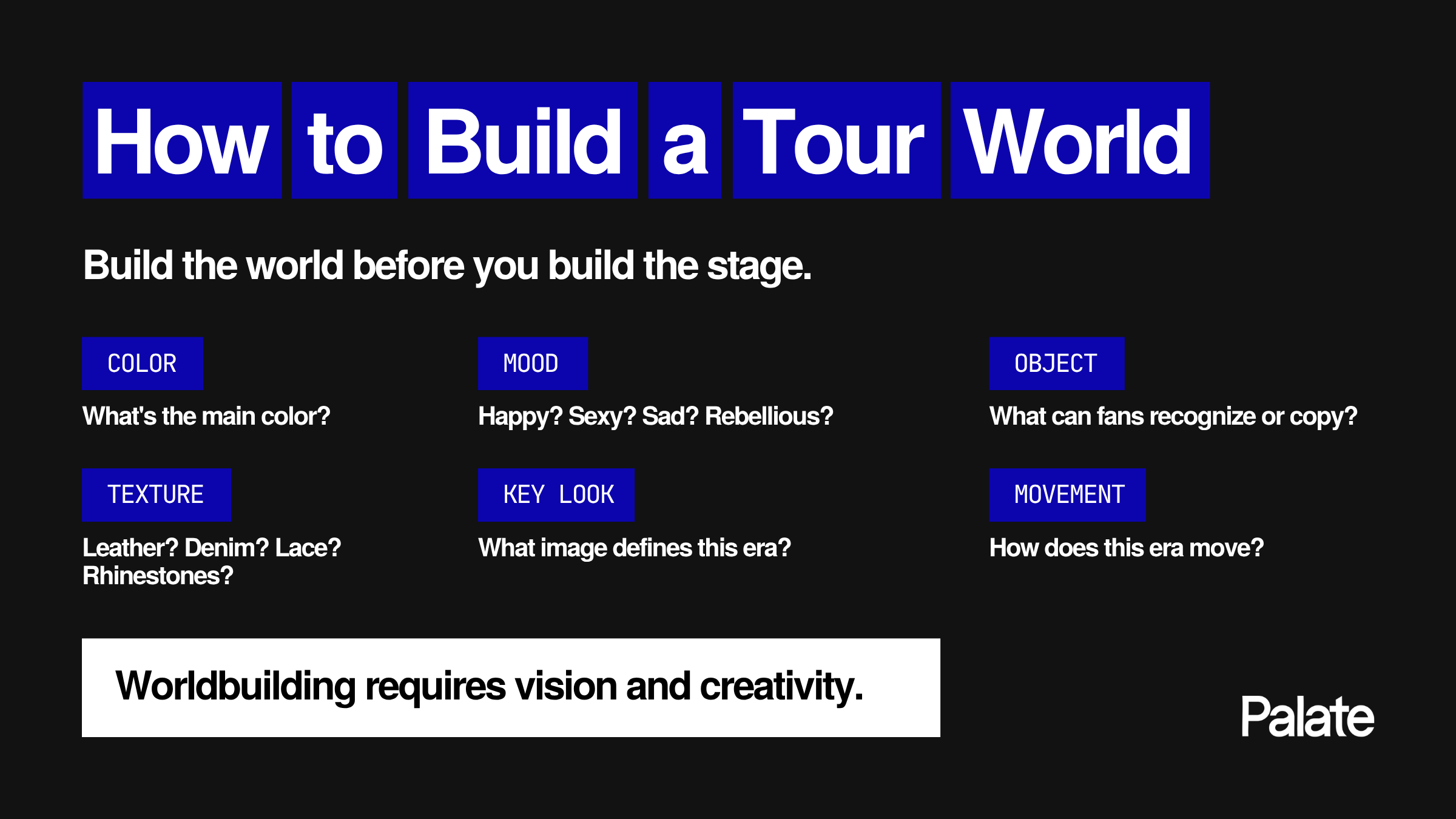
That world can be built around a handful of recognizable elements: color, key look, texture, object, mood, and movement. What is the dominant palette? Is there an image that defines the era? Does leather, denim, lace, or another texture continually appear? Is there an object fans recognize? How does the era feel, and how does it move?
None of those elements needs to be complicated on its own. Their power comes from consistency. When the same visual language repeats across different parts of the artist’s world, the audience begins to recognize it without needing the artist’s name attached.
The Concert Uniform Builds the Tour World
Fans don’t only consume an artist’s world. At its best, live music gives them a way to become part of it.
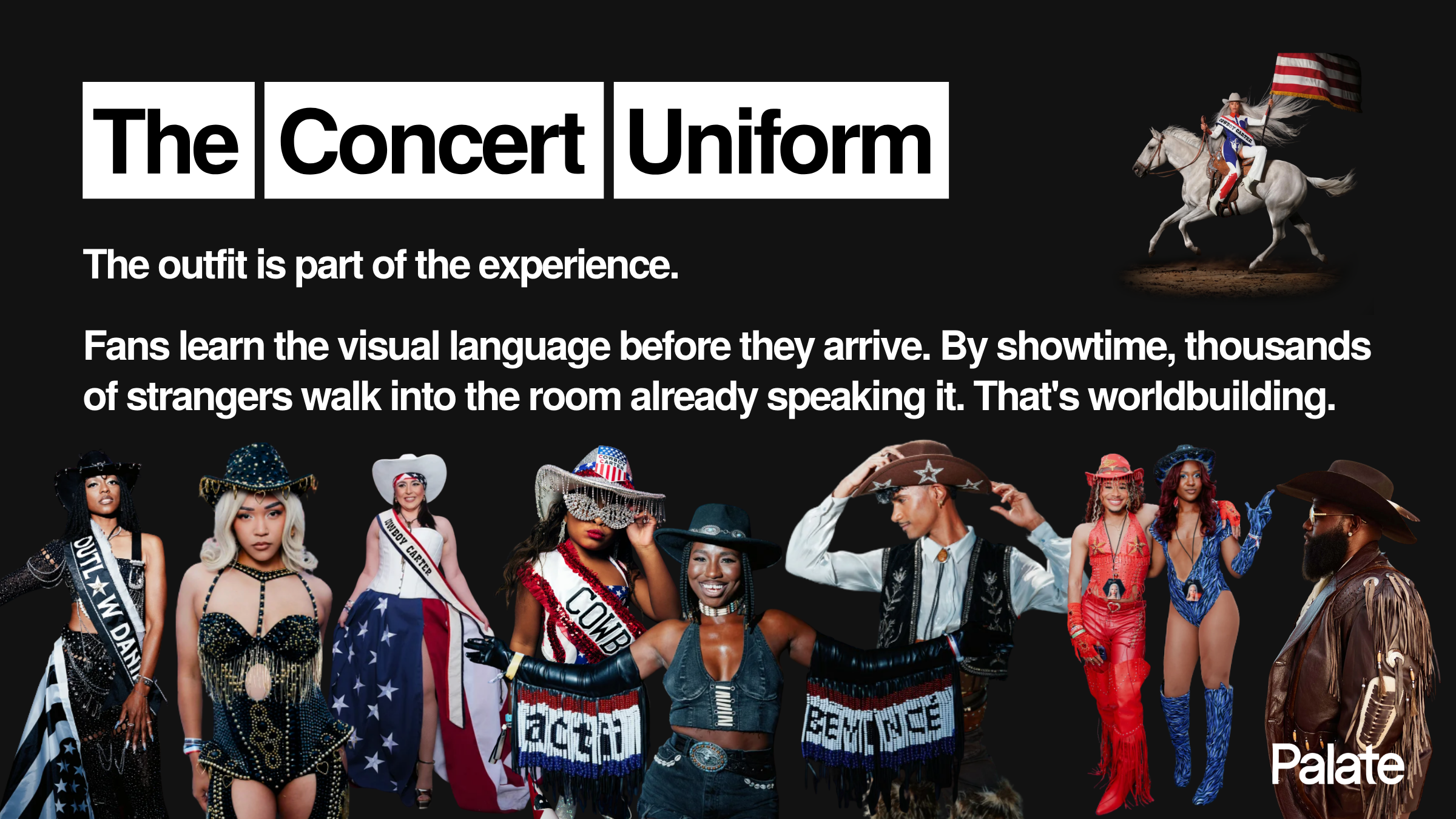
A recognizable concert uniform can turn individual fans into a visible community. By showtime, thousands of strangers may walk into the same room already speaking the same visual language because they understood what the era invited them to wear.
That participation changes the atmosphere before the artist even takes the stage. The outfit becomes part of the experience, the photographs, and eventually the memory fans associate with that period of the artist’s career.
Merch Is More Than Something to Sell
The best merchandise survives the tour. A limited art book, jacket, towel, poster, or instantly recognizable piece of clothing can become a physical artifact of an artist era rather than simply another item at a merch table.
That changes the role merchandise can play. It still generates revenue, but it can also extend the visual world beyond the venue and give fans something tangible that represents their participation in it.
The strongest merch therefore feels connected to the artist, the tour, and the moment. It becomes proof that someone was there.
The Show Can Become Part of the Artist’s Catalog
Some performances become bigger than the night they happened. James Brown’s Live at the Apollo, Bob Marley & The Wailers’ Live!, Nirvana’s MTV Unplugged in New York, and Beyoncé’s Homecoming: The Live Album demonstrate how a live experience can eventually become part of an artist’s body of work.
A tour can generate recordings, films, photography, merchandise, cultural moments, and memories that continue circulating long after the final date. Seen that way, live is not necessarily the end of a campaign.
The experience itself can create the next piece of the catalog.
What Happens After the Show?
This may be one of the most overlooked parts of touring. Artists spend enormous amounts of time and money getting people into a room, only to lose the relationship with them the next morning.
A stronger live strategy thinks in three stages: the show, the relationship, and the next move. First, create an experience people remember. Then understand who showed up. Finally, give those people a reason to remain connected.
Artists do not need an arena to build this kind of live business. The principle works at every level because the important part is not the size of the crowd. It is whether attendance becomes the beginning of a deeper relationship rather than the end of a transaction.
Turn the Crowd Into a Community
A ticket buyer is one of the strongest audience signals an artist can receive because they didn’t simply stream, follow, or scroll past something. They showed up.
Whenever possible, artists should understand who those people are. Email, phone number, city, merchandise purchases, and ticket history can help turn an anonymous crowd into an identifiable fan community.
Then give those people a reason to stay connected. Early ticket access, new music, exclusive merchandise, future shows, and fan experiences can continue the relationship that started in the room.
Don’t just sell the ticket. Know who bought it.
Common Mistakes Artists Make With Touring
One of the biggest mistakes is assuming streams automatically translate into ticket sales. They measure different levels of fan commitment, and a large digital audience may contain many people who like a song without having developed enough attachment to attend a show.
Another is booking for perception instead of demand. An oversized, half-empty room rarely creates a stronger experience than an appropriately sized sold-out show. The venue should reflect where the artist actually is, not where the team wants the industry to believe they are.
Artists can also focus so heavily on getting people into the venue that they overlook what happens once fans arrive—or what happens after they leave. The show itself needs to reward attendance, while the strategy afterward should give the relationship somewhere to go.
Finally, the concert shouldn’t be treated as separate from the artist’s larger world. Styling, stage design, merchandise, audience behavior, and atmosphere can all strengthen—or weaken—the identity being built everywhere else.
The Artist Touring Checklist
Measure actual market-level ticket demand before choosing venue sizes.
Separate streaming performance from demonstrated fan demand.
Define the visual world of the tour before designing the stage.
Identify one or two elements fans can recognize, wear or participate in.
Build memorable moments specifically for the live environment.
Price tickets with both accessibility and tour economics in mind.
Treat merchandise as part of the tour world rather than an afterthought.
Create a strategy for capturing relationships with ticket buyers.
Give fans a clear reason to remain connected after the show.
Ask whether the experience gives audiences something streaming cannot.
Key Takeaways
Streaming made music easier to access. That makes the physical experience more—not less—important. Fans now have to make an intentional decision to leave home, spend money, and enter an artist’s world, which means the experience has to justify that investment.
Streams can create awareness, but they don’t automatically create ticket demand. The strongest live businesses move audiences from liking the song, to caring about the artist, to feeling that they need to experience the music in person.
And the opportunity doesn’t end when the lights come up. A memorable show can deepen the fan relationship, strengthen the artist’s identity, generate merchandise and content, become part of the catalog, and turn a room full of ticket buyers into a lasting community.
Frequently Asked Questions
How do artists know if they’re ready to tour?
Look beyond total streams or followers. Market-level demand, fan community, catalog depth, live-show quality, pricing, timing and the strength of the artist all contribute to whether people will actually buy tickets.
Do streaming numbers predict concert ticket sales?
Not necessarily. Streaming indicates consumption, while purchasing a ticket requires a much higher level of commitment. A large streaming audience can include many casual listeners who aren’t yet invested enough to attend a show.
Is it better to sell out a small venue or play a bigger room?
A smaller sold-out room can often create a stronger experience than an oversized venue. The appropriate choice depends on real ticket demand, the economics of the show and the artist’s development stage.
How can artists make concerts more memorable?
Build a recognizable world around the performance. Styling, color, stage design, movement, merchandise, fan participation and signature moments can all help transform a set of songs into a distinctive experience.
Why is worldbuilding important for touring?
A strong tour world gives fans recognizable visual and cultural signals to participate in. When fans know how to dress, what objects symbolize an era or what moments to anticipate, the audience becomes part of the experience.
What should artists do with fans after a concert?
Maintain the relationship. Where possible, capture direct fan information and give ticket buyers reasons to stay connected through future shows, early access, new music, merchandise and fan experiences.
The Live Experience Matters More Than Ever
Music is easier to access than it has ever been. Being there isn’t.
It costs money. It takes time. Fans have to leave home and choose to spend part of their lives inside an artist’s world. That makes live music uniquely valuable precisely because it cannot be reduced to another piece of content available on demand.
The strongest artists understand that they are not simply performing songs in a room. They are creating a memory, giving fans a world to enter, and allowing people who care about the same thing to experience it together.
The artists who understand that aren’t simply building better concerts. They’re building stronger live businesses and deeper fan relationships.
