The New Model: The Artist as a Start Up
Artists are often told to think like creators. Make the music, build the world, tell the story, find the audience, and keep releasing.
But building a sustainable career requires another way of thinking too: the artist as a start up.
That doesn’t mean treating art like a spreadsheet or turning every creative decision into a business decision. It means understanding that a career needs an operating system capable of turning great music into something that can grow, sustain itself, and become more valuable over time.
The music is the product. The audience is the market. The story is the brand. The marketing creates the signal. And the goal is not simply to generate visibility around the next release. It is to build something that compounds.
Quick Answer: What Is the New Model for Building an Artist Career?
The new model is built around a simple idea: visibility is not a business. An artist can have streams, followers, viral moments, and cultural attention without owning much of the relationship that created them.
A sustainable artist business needs to be repeatable, measurable, and scalable. That means asking different questions. What do you own? Who shows up without the algorithm? What continues generating value when there isn’t a new release to promote?
Palate Case Study State of the Music Business 2026 - Part 4.pdf
The framework looks like this:
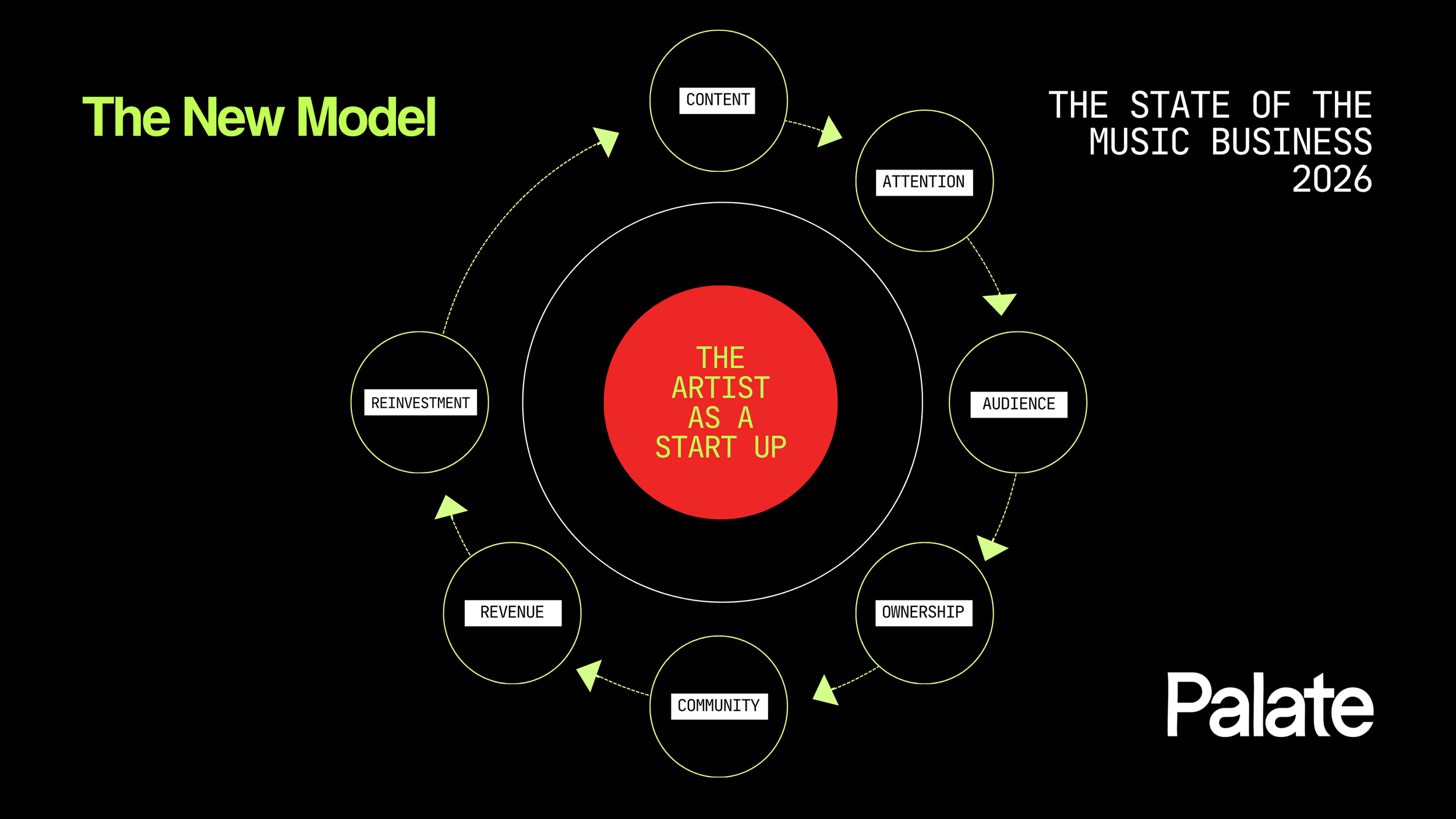
Content → Attention → Audience → Ownership → Community → Revenue → Reinvestment
This isn’t a campaign or a release cycle. It’s a flywheel. Each part feeds the next, and over time, the goal is for every loop to make the business stronger than it was before.
Explore The New Model: The Artist as a Start Up Visual Report
Start With the Product
Every artist business starts in the same place: the music. Before the content strategy, audience funnel, merch, partnerships, or monetization, there needs to be something people actually care about.
What changes from era to era is how artists get that music in front of people. The mixtape era rewarded artists willing to drop music for free and flood the streets. SoundCloud removed another layer of gatekeeping, allowing artists to record in bedrooms and upload whenever they wanted. Today, the content era gives artists another distribution layer.
The format has changed, but the underlying work ethic hasn’t. Artists still need to make something worth discovering and repeatedly put it where people can find it.
Content should not be dismissed as the cheap version of traditional marketing. It is part of the new distribution layer.
Content Creates Attention
The content era has already moved through different waves, and each one has rewarded slightly different behavior. Doja Cat represented an internet-native approach built around humor, volume, and constant presence. Ice Spice demonstrated the power of simple moments and repeatable formats. Tyla represents another evolution: global sound, dance, strong identity, and cultural crossover.
The tactics change because platforms and culture change. The underlying principles are much more consistent: consistency, clarity, and repetition.
The lesson isn’t to copy whichever artist currently understands the internet best. It’s to identify the intersection between your music, personality, audience, and cultural lane, then create enough repetition for people to recognize it.
Find your lane. Then flood it.
Attention Has to Become an Audience
Attention is useful, but attention alone is fragile. Someone watching a video once does not necessarily mean they know the artist, remember the artist, or care what the artist does next.
That distinction has become increasingly important because almost every visible metric can be manipulated. Streams can be bought. Followers can be bought. Comments can be bought. A career can be made to look healthier from the outside than it actually is.
But perception has limits. Artificial activity cannot reliably sell a ticket, sustain a community, or create the kind of fan who keeps showing up.
Make great music. Earn the audience.
Followers Are Not Ownership
Once attention becomes an audience, the next question is one of the most important in the entire model: Do you actually own the relationship?
A million followers on a platform can be incredibly valuable, but the platform still controls access to them. Algorithms change. Reach drops. Accounts disappear. Platforms rise and fall. An artist who builds their entire audience on rented infrastructure remains dependent on someone else deciding when and whether their fans see them.
Ownership means building direct connections through tools like email, SMS, and community. If the platform disappears tomorrow, can you still reach the people who care about you?
That doesn’t mean abandoning social media. Social platforms remain extraordinary tools for discovery and attention. The goal is to use rented platforms to help build something you can carry with you.
Community Is More Valuable Than Reach
A follower can be passive. A community participates.
That distinction changes the economics of an artist career. Attention can arrive quickly, but community has to be earned. The people who sustain an artist are not usually the ones who happened to scroll past a clip once. They are the people who care enough to stay.
Those are the fans who buy tickets, buy merch, show up to events, tell friends about the music, and participate in whatever the artist builds next. Revenue becomes a result of the relationship rather than a desperate attempt to monetize attention before it disappears.
The goal, then, isn’t simply to make the audience bigger. It is to make the relationship deeper.
Build a World, Not Just Merch
Once an artist has community, the commercial possibilities become much more interesting. Merch can be part of that business, but putting an artist’s face on a T-shirt is not the same thing as building a brand.
The bigger opportunity is creating a world people want to participate in. Product can be part of it. So can events, pop-ups, live experiences, fan activations, collaborations, and physical spaces that make the artist’s identity tangible.
The most powerful experiences also create something an algorithm cannot replicate: a memory. A sold-out pop-up or a room full of people participating in an artist’s world creates a different kind of attachment than another impression in a feed.
The ceiling is how far you are willing to build.
Revenue Should Feed the Business
Making money is not the end of the flywheel. Reinvestment is what closes the loop.
This is where an artist career begins to operate more like a sustainable company. Revenue from tickets, merch, streaming, sync, partnerships, or other sources can fund better content, stronger teams, more ambitious creative ideas, and the next rollout.
When all of the revenue leaves the business, the next release starts from zero again. The artist has to rebuild momentum and find new money every time.
Reinvestment changes that. The previous cycle helps finance the next one, allowing the business to compound rather than continually reset.
Fund your business. Not just your lifestyle.
Catalog Is the Asset
The startup model also changes how artists should think about time. A release is not only valuable during the weeks surrounding its launch.
New music is competing alongside decades of existing music every day. Older songs can return through discovery, anniversaries, vinyl, touring, sync, social platforms, or cultural rediscovery. A project that feels finished from a marketing perspective may still have decades of economic and cultural life ahead of it.
That makes catalog one of the most important assets an artist can build. The goal shouldn’t be to create disposable releases that only matter while the campaign is active. It should be to build work with the potential to keep generating attention, meaning, and revenue long after release week.
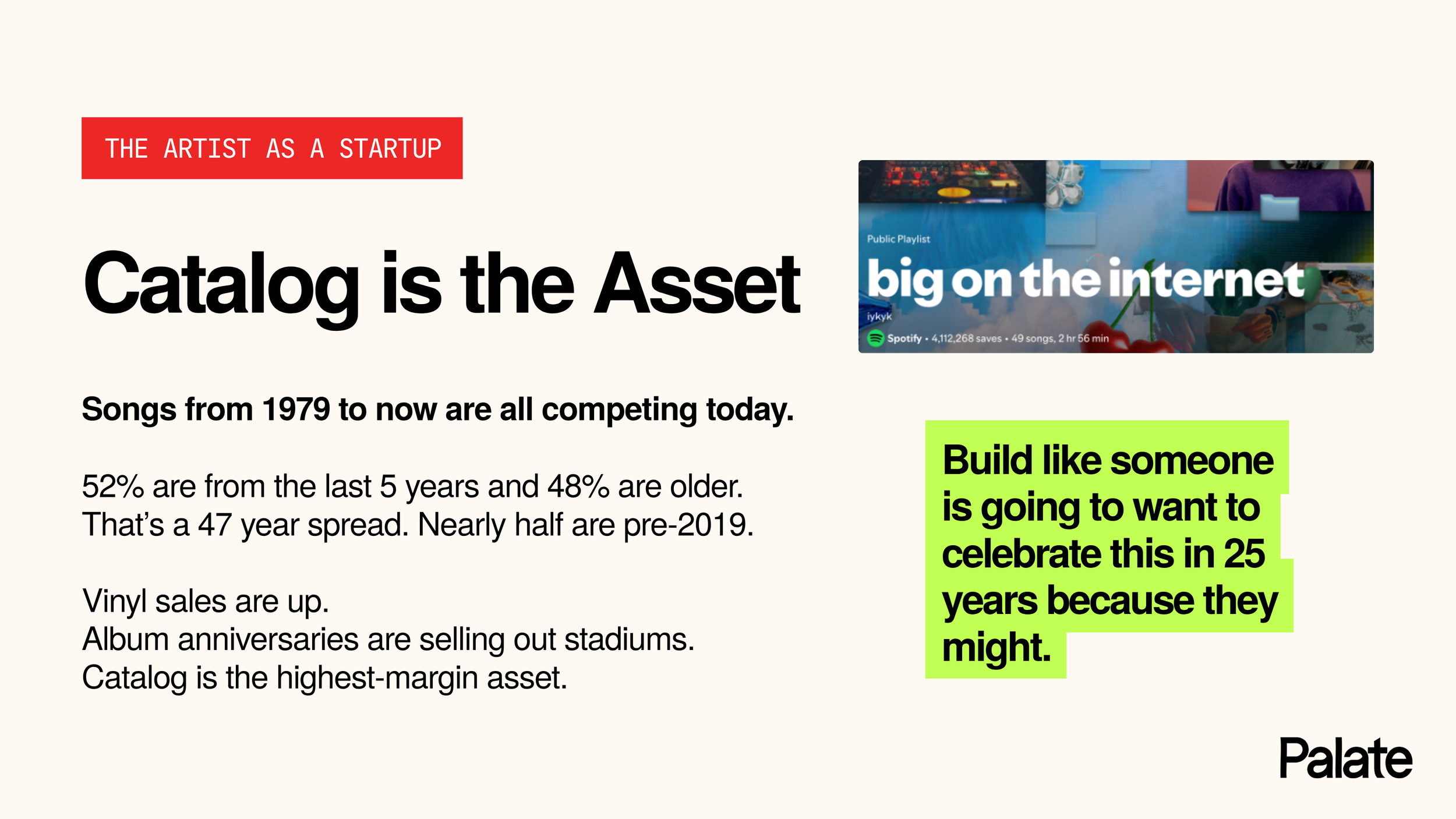
Build like someone is going to want to celebrate this in 25 years, because they might.
The New Definition of Success
The old model often put the industry before the audience. Get discovered, secure the deal, gain access to infrastructure, and hope that infrastructure creates the audience.
The emerging model can work in the opposite direction. You release a project and your community begins amplifying it before the algorithm notices. The algorithm notices because people are responding. Eventually, the industry notices because there is evidence that something real is happening.
That changes the artist’s leverage. Instead of approaching every opportunity from a position of needing someone else to create momentum, the artist can negotiate from a position of already having it.
From strength. Not desperation.
Build the Foundation First
None of this works without a foundation. Before an artist starts thinking about scale, the business needs four essentials: Story. Audience. Catalog. Revenue.
The story needs to be clear enough that a new fan can understand the artist. The audience needs to include direct relationships the artist can actually own. The catalog needs to accumulate value rather than disappear after each rollout. And ideally, at least one income stream should exist that does not require constantly releasing something new.
The point isn’t to transform every artist into a founder obsessed with optimization. It is to create enough structure around the art that the career has room to survive, grow, and compound.
Common Mistakes
One of the biggest mistakes is confusing visibility with a functioning business. Streams, followers, press, and viral moments can all be valuable, but none of them automatically creates ownership, community, or sustainable revenue. Attention is the beginning of the flywheel, not the end.
Another mistake is trying to monetize an audience before earning its trust. A merch store does not create community, just as a follower count does not create ownership. The strongest commercial opportunities tend to emerge after people already care enough to participate.
Artists can also become trapped in the release-cycle mindset, treating every project like a new business that has to start from zero. Without audience ownership, catalog strategy, and reinvestment, momentum disappears between releases. The goal should be to make each cycle strengthen the next one.
The Artist as a Start Up Checklist
Before trying to scale, ask:
Is the music strong enough to be the product everything else is built around?
Is our content consistently creating attention?
Is that attention becoming a recognizable audience?
Are we building direct audience ownership through email, SMS or community?
Are followers becoming real fans?
Are we creating experiences that deepen the relationship?
Do we have revenue streams beyond a single release?
Are we reinvesting revenue into content, team and rollout?
Are we treating our catalog as a long-term asset?
Is our story clear enough that a new fan understands it immediately?
Do we have at least one income stream that doesn’t require a new release?
Is each cycle making the business stronger than the one before it?
If the answer to most of those questions is no, the goal probably isn’t scale yet. It’s building the foundation.
Key Takeaways
The artist as a start up is not about putting business ahead of creativity. It is about building a system capable of supporting creativity over time.
Content creates attention. Attention builds an audience. Audience ownership creates a direct relationship. That relationship can become community, community can generate revenue, and revenue can be reinvested into the next cycle. Meanwhile, the catalog continues accumulating value in the background.
The most important shift is from chasing visibility to building something the artist actually owns. Visibility can create a moment. Ownership is what gives that moment somewhere to go.
Frequently Asked Questions
What Does “The Artist as a Start Up” Mean?
It means thinking about an artist career as a business capable of growing and compounding over time. The music is the product, the audience is the market, the story is the brand, and marketing creates the signal around it.
Why Is Audience Ownership Important for Artists?
Social platforms control access to followers. Building direct relationships through email, SMS, and community gives artists a way to reach core fans without depending entirely on an algorithm.
Are Followers the Same as Fans?
No. A follower represents some level of attention, but a fan has a deeper relationship with the artist. Fans are more likely to listen repeatedly, buy tickets or products, attend events, and participate in the artist’s community.
How Do Artists Turn Attention Into Revenue?
The process usually requires something between attention and monetization: a relationship. Attention can become an audience, an audience can become a community, and a strong community creates opportunities around tickets, merch, experiences, partnerships, and other revenue streams.
Why Should Artists Reinvest Their Revenue?
Reinvestment allows one successful cycle to help fund the next. Putting revenue back into content, team, creative development, and future rollouts can prevent every release from having to start from zero.
Why Is an Artist’s Catalog an Asset?
Music can continue generating discovery, cultural relevance, and revenue long after its original release cycle. Treating catalog as a long-term asset changes the goal from creating temporary moments to building work that can compound in value over time.
Explore the Master Case Study
The New Model: The Artist as a Start Up is part of Palate’s The State of the Music Business 2026 series. Go deeper with the full Master Case Study.
