
Why Most Rollouts Fail: The Three Things Every Artist Should Know Before Spending

Most music rollouts do not fail because the music is bad. They fail because the strategy was built for the wrong artist, the wrong budget, or the wrong partner.
An emerging artist copies the campaign of someone with millions of fans. A developing artist spends like an established act because momentum makes the team feel further along than it actually is. An artist signs with a partner whose infrastructure has little to do with the lane they are trying to build. Then everyone wonders why the campaign didn’t convert.
Before deciding how to market a release, three things have to align: Artist Level. Marketing Budget. Release Partner.
If they don’t match, the rollout can be dead before it starts.
Quick Answer: Why Do Most Music Rollouts Fail?
Most rollout problems are actually alignment problems. The strategy has to match where the artist is in their career, what they can realistically afford to execute, and what their release partner can actually provide.
The mistake is treating rollout strategy as universal. It isn’t. The strategy that works for an established artist can bury an emerging one. A $5,000 budget should not imitate a $250,000 campaign, and releasing independently requires a completely different operating system than releasing through a major label.
Before asking What should we do for this rollout?, ask three more useful questions: Who is the artist? What resources actually exist? And who is responsible for helping execute it?
Explore the Why Most Rollouts Fail Report
Know Your Artist Level
One of the biggest problems in music marketing is that artists consume advice without knowing who that advice was designed for. There are three fundamentally different games being played: Emerging. Developing. Established.
These aren’t simply different levels of popularity. Each requires different priorities, expectations, teams, and strategies. Advice that makes perfect sense at one level can create unnecessary expense or pressure at another.

Emerging Artist: Build Before You Scale
At the emerging level, you are building from zero. The team may effectively be two people: someone helping manage the chaos and someone helping shape the creative. Everyone is learning, and that isn’t necessarily a weakness. It’s part of the stage.
The goal is not to recreate the infrastructure surrounding an established artist. It’s to develop the artist enough to understand what actually deserves infrastructure later. You need repetition, a recognizable story, an understanding of what connects, and some proof that people beyond your immediate circle care.
Hiring a large team before those things exist doesn’t make an emerging artist established. It just makes the emerging stage more expensive.
Developing Artist: Don’t Confuse Motion With Scale
This is where things get complicated. Now there is an audience. People are paying attention, the team starts expanding, and there may be a manager, creative collaborators, a distribution partner, and some level of funding.
The danger is that everyone begins behaving as though the artist has already arrived. Momentum can disguise development, making an artist look established publicly while the business underneath them is still catching up.
That mismatch creates expectations the audience, revenue, and infrastructure may not be ready to support. Growth should change the strategy. It shouldn’t convince you to skip a stage.
Established Artist: Sustain the Business
At the established level, the problem changes again. You’re no longer primarily trying to prove that people care; you’re trying to sustain what has already been built.
Every move becomes more expensive, every decision is amplified, and every mistake becomes more visible. A publicist, booking agent, commerce lead, and larger infrastructure now make sense because there is enough demand to require them.
The team exists to support the business, not to make the artist look like a business.
Your Marketing Budget Changes the Game
Once you understand the artist level, you can talk realistically about money. A common mistake is treating a larger budget as though it simply buys a bigger version of the same campaign. It doesn’t. Each budget level changes what the strategy should be designed to accomplish.
The framework breaks marketing budgets into five levels: $0–$5K+, $10K+, $25K+, $50K+, and $250K+. These aren’t simply spending tiers. They represent different levels of execution and different strategic decisions.

Level 1: $0–$5K+
At this level, think reps, not rollout. Creativity is the budget. Your phone may be your studio, camera, and distribution system, while favors and relationships fill the gaps money cannot.
This is not the moment to hire a miniature version of an established artist’s team. Put in the reps, build the story before building the team, and choose consistency over unnecessary production. The goal is to learn what actually works before you start spending significant money trying to amplify it.
Level 2: $10K+
Now you have something to work with, but not enough to do everything. That makes focus more important.
Ask what one investment could move the needle most. Maybe it’s the visuals. Maybe it’s the sound. Maybe it’s one specific moment designed to create attention. Put meaningful resources there and allow everything else to remain scrappy.
Trying to make every component of the campaign look expensive usually results in nothing receiving enough investment to matter.
Level 3: $25K+
At $25K+, a real campaign becomes possible. It may still be relatively small, but it can be structured, which means build order starts to matter.
The wrong hire can consume a meaningful percentage of the budget while delaying the campaign. A strong creative partner becomes more valuable, the rollout should have an actual plan, and the activity should be building toward something rather than existing as a collection of disconnected deliverables.
Ideally, there is at least one moment designed to turn attention into actual fans.
Level 4: $50K+
At this point, the strategy needs to become much tighter. Press, content, distribution, and activation can begin working together rather than operating as isolated pieces.
Every dollar needs a job, and every move should feed the next one. Nothing should exist simply because someone said, That’s what you’re supposed to do during a rollout.
The larger the campaign becomes, the more expensive random activity gets.
Level 5: $250K+
A six-figure budget creates real options. It also creates the ability to waste six figures.
Money can amplify something that is already connecting, but it cannot manufacture a foundation that isn’t there. Proof of audience still matters. Artist identity still matters. Strategy still matters.
At this level, mistakes become extremely expensive. Someone on the team should have been here before.
Know Your Release Partner
Once you know the artist level and budget, the third variable is who you are releasing with. There are endless companies, services, and deal structures in music, but they generally lead back to three broad paths: Distributor. Indie Label. Major Label.
Each path changes what the artist controls, what support may exist, and what the artist and team remain responsible for.
Door 1: Distributor
Independent distribution offers enormous control, but it also comes with enormous responsibility. At its most basic level, a distributor gets the music onto platforms. Everything beyond that needs to be understood clearly rather than assumed.
Who funds the campaign? Who develops the artist? Who manages the narrative? Who builds the marketing and visual world? Who finds the audience?
Often, the answer is the artist and their team.
Artists sometimes choose independence because it sounds like freedom, but independence is also responsibility. Ownership and control are valuable. Neither automatically provides the infrastructure required to use them well.
Door 2: Indie Label
An indie label can be an extremely valuable partner when there is a clear reason for the match. The most useful questions are whether they understand your genre, whether they have experience in your region, and whether they have a proven history developing your sound.
If you can’t identify why that particular company is positioned to help your career, you’re guessing. The logo on the contract matters less than the partner’s proof in your lane.
If they don’t have proof there, you may be the experiment.
Door 3: Major Label
Major labels can provide capital, infrastructure, relationships, and scale, but they are also businesses managing risk.
An artist becomes particularly attractive when there is either visible proof of audience or a meaningful relationship providing validation. Maybe the numbers confirm that something is already happening. Maybe a manager with a track record, a producer with momentum, or another trusted industry relationship has vouched for the artist.
In both cases, the underlying principle is similar: investment becomes easier when the artist looks like less of a risk. That doesn’t mean an artist needs to arrive completely built, but momentum, identity, audience, and trusted relationships can materially change the conversation.
The Three Variables Have to Match
This is where the framework becomes useful in practice.
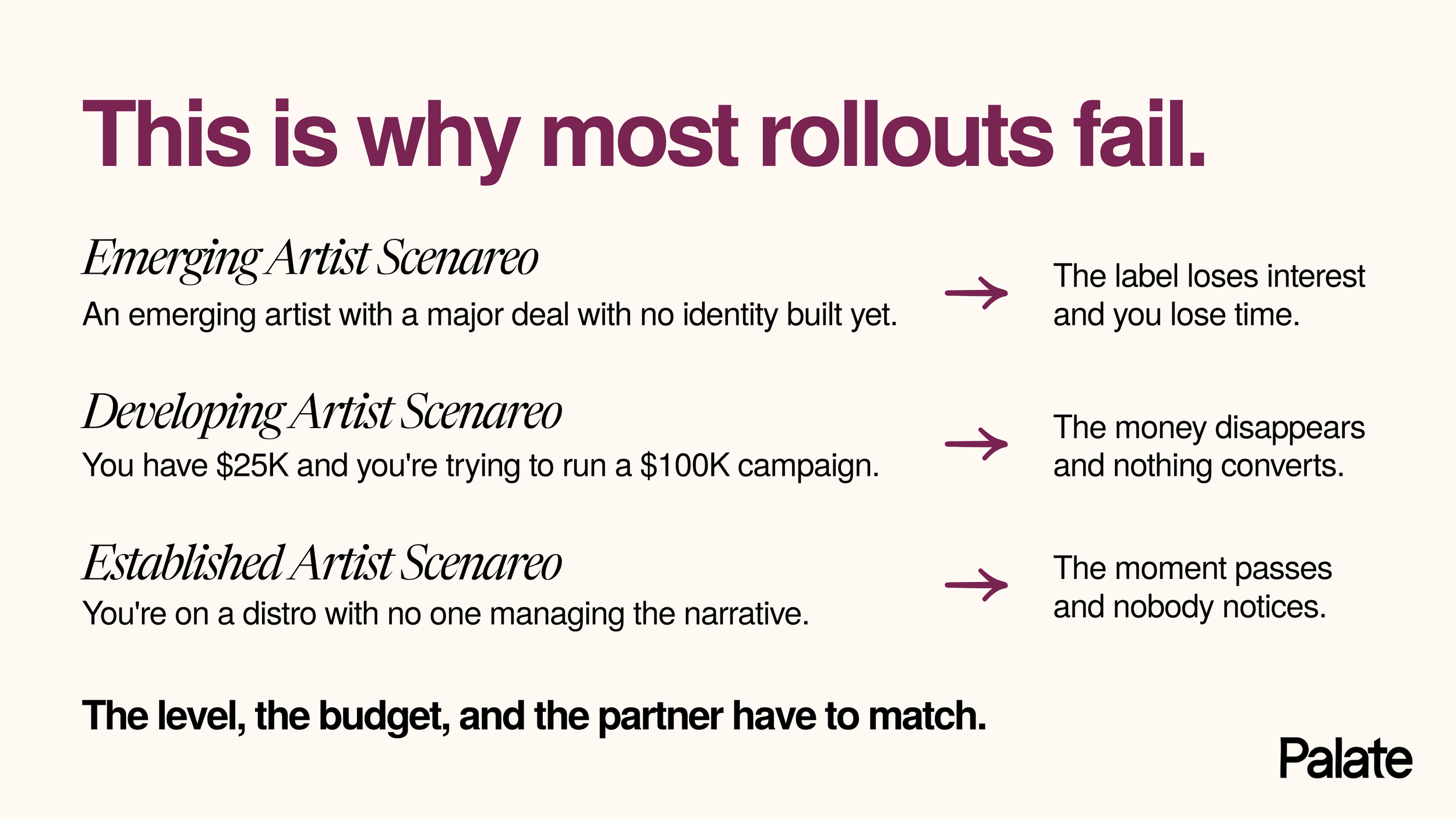
Imagine an emerging artist with a major-label deal but no developed identity. The partner may be large, but the artist isn’t ready for what the infrastructure expects. The label loses interest and the artist loses time.
Now imagine a developing artist with $25,000 trying to execute a campaign designed for $100,000. The ideas may be good, but the economics aren’t. Money gets distributed across too many pieces and nothing receives enough investment to convert.
Or consider an established artist releasing through distribution without anyone taking responsibility for the narrative. The music gets delivered, but the moment passes without the surrounding strategy required to make people notice.
On the surface, these look like three different problems. Underneath, they are the same problem: the artist level, marketing budget, and release partner do not match.
Common Rollout Mistakes
A lot of rollout mistakes begin with comparison. Teams copy another artist’s campaign without knowing the budget, relationships, audience data, team structure, or business objective underneath it. What looks like a clever tactic from the outside may only have worked because of infrastructure you cannot see.
Another common mistake is building an established campaign around an emerging artist. Looking expensive is not the same as being developed. The same goes for hiring too many people too early. Team size should grow in response to actual needs and demand, not because a larger team makes the campaign feel more legitimate.
Limited budgets also get spread too thin. Instead of making one or two meaningful investments, teams try to improve every part of the campaign slightly. Choosing partners for status creates a similar problem: the right partner is the one with evidence they can help build what you’re actually building.
And perhaps most importantly, money should not be confused with momentum. Money can amplify what is already working, but it cannot manufacture the foundation a campaign is missing.
The Pre-Rollout Checklist
Before spending a dollar, ask:
Are we emerging, developing or established?
Are we planning for our actual level or the level we want people to think we’re at?
What is the real marketing budget?
What can that budget execute well?
What are we deliberately not spending on?
What single investment could move the needle most?
Who is releasing the music?
What does that partner actually provide?
What remains our responsibility?
Does the partner have proof in our genre, region or sound?
Does the campaign have a clear objective?
Is each expense connected to that objective?
What should exist after the rollout that didn’t exist before it?
If those answers aren’t clear, the campaign probably isn’t ready to spend.
Key Takeaways
A rollout isn’t a checklist of content, press, playlists, visuals, and social posts. It’s a strategy built around the reality of a specific artist.
An emerging artist needs development and repetition. A developing artist needs focus and smart resource allocation. An established artist needs infrastructure capable of sustaining demand. The budget determines what can actually be executed, while the release partner determines what infrastructure is available and what responsibilities remain with the artist and team.
When those three variables align, the rollout has a foundation. When they don’t, more content, more money, and more activity rarely solve the underlying problem.
Before you spend a dollar: know your level, know your budget, know your partner.
Frequently Asked Questions
How Much Should an Independent Artist Spend on a Music Rollout?
There isn’t one correct number. Budget should reflect the artist’s current level, available resources and campaign objective. A smaller focused campaign can be more effective than a larger budget spread across tactics that aren’t appropriate for the artist yet.
What Should an Emerging Artist Spend Money On First?
First determine what is already connecting. At the earliest stage, repetition, story and creative development matter more than building a large team. When money becomes available, concentrate it around the area most likely to meaningfully improve the artist’s development or audience response.
Does a Bigger Music Marketing Budget Guarantee Better Results?
No. A larger budget provides more options and greater amplification, but it also increases the amount of money that can be wasted. Budget cannot replace artist identity, audience proof or strategy.
Is Independent Distribution Better Than Signing With a Label?
Neither is automatically better. Distribution generally offers greater control while leaving more responsibility with the artist. A label can provide additional infrastructure, funding and relationships, but the value depends on the specific partner and deal.
When Is an Artist Ready for a Bigger Team?
When actual demand creates jobs that need to be done. Building a large team to signal success can add cost before the business exists to support it.
Why Do Music Rollouts Fail?
A major reason is misalignment between the artist’s level, available marketing budget and release partner. The strategy needs to be designed around all three.
Explore the Master Case Study
Why Most Rollouts Fail is part of Palate’s The State of the Music Business 2026 series. Go deeper with the full Master Case Study.
